Using Gaussian Noise
Simulate with Python

Gaussian noise is a type of random noise that follows a normal distribution, and it is widely used in various data exercises. It can be a very useful tool to simulate realistic scenarios, add variability to data, and generate synthetic data for testing and validation.
Simulating Realistic Scenarios
The common use of Gaussian noise is to simulate realistic scenarios. In epidemiology, researchers may add Gaussian noise to the reported number of cases or deaths to account for underreporting or errors in measurement. In financial modeling, researchers may add Gaussian noise to stock prices or interest rates to simulate market fluctuations.
In my recent Medium article, I have introduced Gaussian noise to simulate transaction environments in the real world, so Python could be better trained to make more accurate predictions when put in use.

Adding Variability to Data
Gaussian noise can also be useful in adding variability to data. This can be useful when the data is too perfect or has low variability, which can result in overfitting and unrealistic models. By adding Gaussian noise to the data, researchers can introduce a level of randomness that makes the data more representative of the real world.
Generating Synthetic Data
Gaussian noise can be used to generate synthetic data for testing and validation when the real-world data is scarce or when it's not possible to collect certain types of data. By adding Gaussian noise to existing data, researchers can create new datasets that are statistically similar to the original data, but with added variability.
Computer Vision Task
To illustrate the effect of Gaussian noise, let’s look at an exercise to generate synthetic images of faces for testing and validation. This can start with a clean image and add Gaussian noise to simulate different lighting conditions, camera angles, or other factors that can affect the quality of the image. The following image shows an example of a clean image and a synthetic face image generated with Gaussian noise:
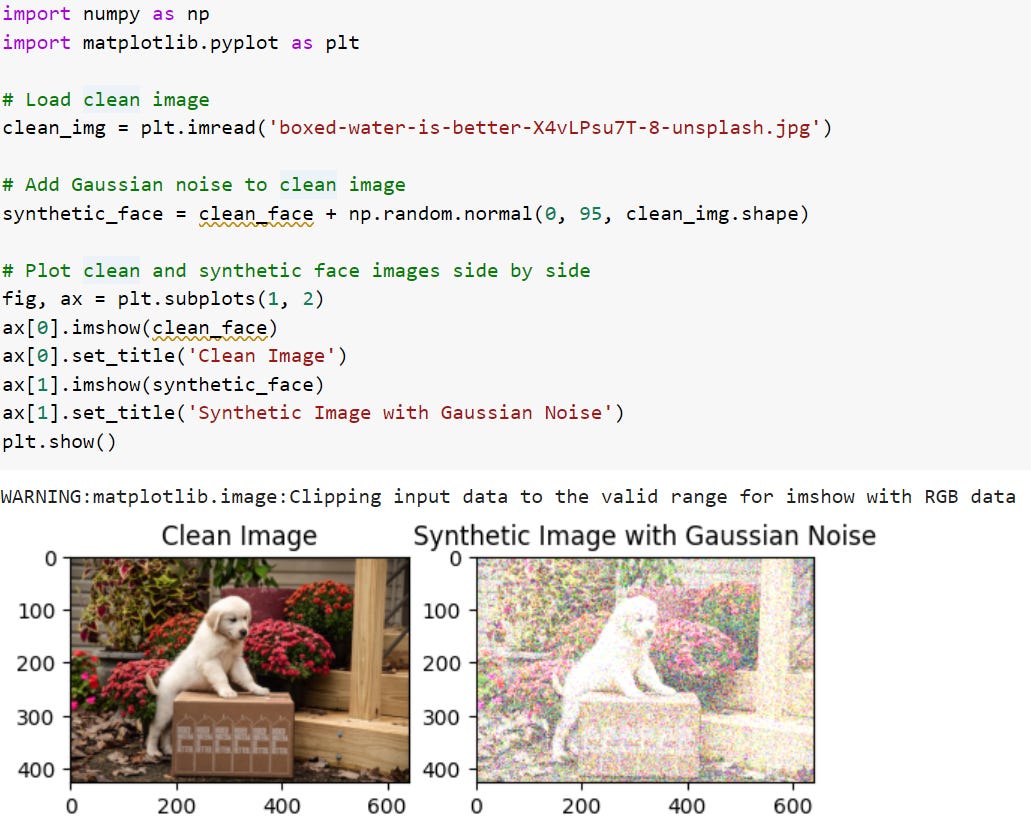
You can clearly see the variability of the synthetic image with Gaussian noise, and with this tool applied to data, analysts are able to improve the quality and accuracy of their data exercises.
Feedback
The Substackers’ message board is a place where you can share your coding journey with me, so that we can exchange ideas and become better together.
Please open the message board and share with me your thoughts!